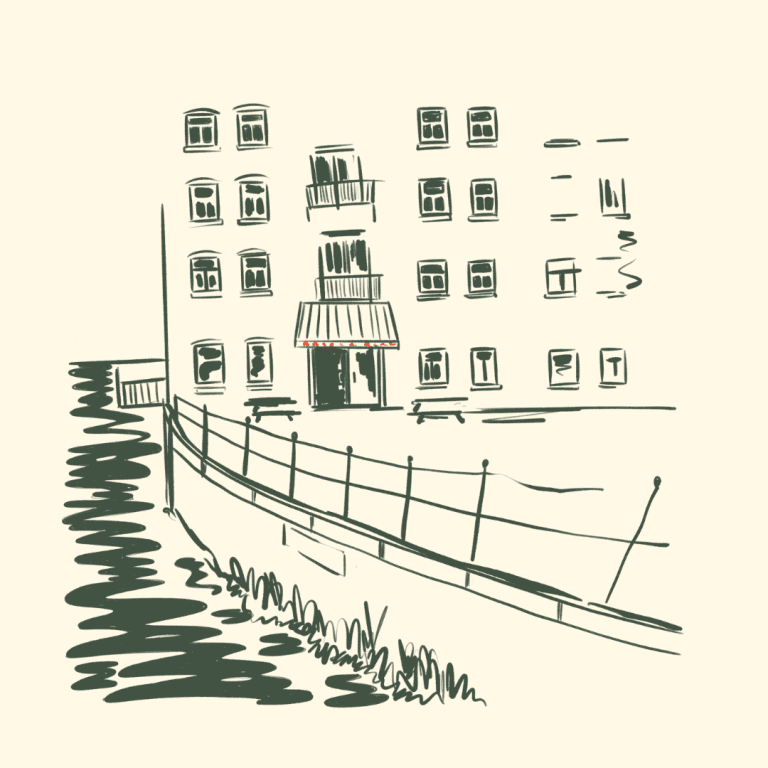
Before embarking on the second of my travelogues you may ask, how do I choose where is next? The simple use of a map and a pin. This protects me against any accusations of bias, though I am not sure how sticking pins in maps of France will be seen by your average French chauvin.
Normandy
Normandy is the area most closely linked to Britain, in France. I am not talking about the large ferries I see passing our newish Brasserie in Portsmouth. Normandy is the birthplace of William the Conqueror, Duke of Normandy. To the locals he was simply known as William the Bastard, more to do with genealogy than his temperament. Technically of course he wasn’t French so I really can’t claim a rare victory.
Etretat
Usually missed by modern French and Brits alike, Etratat’s truly spellbinding coastline attracted such greats as Maupasssant and Monet. If you have seen the grandiose paintings of cliffs by Monet, then you just glimpsed the beauty that is here.
The cliffs are so prized by the French, they have made them a Grand Site National! From the centre of town a leisurely hour’s walk will get you to the Falaise D’Aval and back. This is worth every single step. Maupassant described it as “a large white elephant dipping his trunk in the water”. Cathedral-like in its splendour, the chalk cliff has been slowly eroded to form a flying buttress. Each season, and even each time of day, bathes the cliff in different lights, ranging from serene and elegant to powerful and majestic. A lighting scenario only usually seen in film.
A journey of similar direction to the east will bring you to the Falaise D’amont, though this time, a somewhat perilous staircase cut into the cliff is your right of passage. Again a flying buttress will greet you. This one is chunkier and thicker, and to my taste not as impressive. The very fragility of Aval makes you think it may collapse at any moment, like a large Jenga set.
Nature’s sculptures are dotted around, only improved by the local names; the Man Hole, The Young Ladies Room and a few more.
Etretat town itself does not disappoint; the Halles (covered market) on its own is worth the visit. Though not original, they have been rebuilt and provide shelter and space for stall holders and artisans. A sort of old fashioned supermarket, with a wonderful lack of booze-laden trolleys. Near the market the Manoir De La Salmande is one of the oldest houses in Etratat, only it hides a secret; it is an interloper as it was moved bit by bit from Lisieux where it lived under a different name. I have no idea how or why this happened. Maybe the house had a dark and secret past and wanted to start again fresh, who knows.
The local church Notre Dame, lovely as it is perched on a cliff just outside town, is more interesting for the patchwork nature of the building. Original areas from the 12th century have been added on during the 13th, 14th, 18th and 19th. Part of the cemetery is reserved for graves of Commonwealth soldiers, still meticulously kept they are oddly from the First World War. The reason is simple, a hospital was set up far from the front.
Le Bec-Hellouin
Let’s start with an English connection, Le Bec-Hellouin provided a few Archbishops of Canterbury. Admittedly this was as far back as the 11th century, but still a connection is a connection and I think proves there are far stronger links between my adopted country and my native France than war and rugby.
The village was founded by a knight who apparently swapped his steed for a donkey and devoted himself to God. The little hamlet then called just Bec was soon a thriving community and grew from there. Apart from a blip during the revolution that saw the Abbey Church destroyed, the Abbey has been a constant presence.
This is a working monastery, so do take care. The monks follow three golden rules; the rule of law, the rule of community and the rule of the Abbot. They are rules set by St Benoit and gave rise to what we would term Benedictine monks. In a nutshell St Benoit believed monks should balance the spiritual and the physical, ie they should work their bodies as well as their minds. The physical manifestation of this in Le Bec-Hellouin is some charming pottery made by the monks (available of course in the shop).
The really wonderful thing about the Abbey is the diversity of the architecture and the fact that it is lived in, whilst it is, 10 centuries later, still a work in progress (though this is mainly restoration).
You can follow the suggested route or even go chronologically. I prefer wondering aimlessly, that way the surprise is all the more pleasant. The 15century Tour St. Nicolas is the only part of the old church that remains. This is a forceful stocky building, designed to hold long since gone bells that were said to have rattled the doors of the original church., Now that’s what I call putting the fear of God into people. The cloisters are magnificent and not only worth the visit but worth using; cloisters are places for relaxed contemplation. Take a stroll in the main buildings and gardens – beauty and calm wash over you. The monk’s cells hold a secret; they are larger than that stipulated by St Benoit. Rules are there to be broken I suppose.
The visit is not over, take a tour of the village itself. Chocolate box beauty, the old village is a master class in wattle and daub. Each house seems to vie with its neighbour. Each colour chosen to clash, not in an offensive way, but so as to put a spring in your step as you walk by.
Rouen
Rouen does not generally feature on the great French cities to visit, this is a sad omission. Of course like most cities, there is a nondescript modern part of Rouen that hardly entices the weary traveller but look a tiny bit closer and the old part of town reveals itself to be a small gem.
There is something about towns with large harbours, maybe because they have been exposed to a world beyond or maybe because of the riches they bring; either way it seems to give these towns a swagger, a confidence and a self awareness that its land-locked sisters can never match. Rouen is no different. The 5th busiest port in France, it first announces itself with what is undoubtedly one the finest French Gothic cathedrals; Notre Dame. Started in the 12th century it was not fully completed until the 19th.
After the heavy bombardment during the war, an evident downside of having a harbour, it has been lovingly restored. A small or should I say large piece of trivia, when the cast spire was finally hoisted in the 19th century, Rouen, for a giddying four years, boasted the tallest building in the world. This of course is not the reason to visit, but it does give you an idea of the scale. The real beauty of Rouen’s cathedral is the diversity of architecture 700 odd years of construction bring. Never one to miss a culinary connection; let us start with the Tour De Beurre or Butter Tower. This tower was erected based on a bit of religious accounting – butter was banned during lent. Some of the better-off locals were given dispensation in exchange for a “small” donation. Obviously God recognised that Normandy’s love of butter transcended mere religious law. You may recognise the imposing western front, Monet painted it at various times of the day to demonstrate the different effects of light. The connections between Normandy and the UK continue, inside. Amongst others you will find the final resting place of Richard The Lionheart. It should be noted that this is not the only place he rests, historically speaking, they tended to spread the body parts a bit. Considering his name Rouen got the lion’s share, his heart (sorry couldn’t resist).
The main part of the old Rouen is on the north side of the Seine. A cathedral was not enough, and the place positively bristles with smaller churches, all worth a gander. All of these framed by wonderful half timbered houses and not forgetting the Gros-Horloge. This aptly named clock was actually moved to its present place in 1527, and is a magnificent opportunity to see a tower clock close up. It is a thing of true splendour.
I’ll leave you with a small Normandy related Raymond fact. When I arrived in England I could understand why the English had one word for the living animal but a different word for its meat: lamb, mutton, cow, beef, pig, pork. The answer comes from Normandy or more precisely the Normans. All the words are of French origin: mouton, boeuf and porc. When you are the only ones to have managed to invade a specific country, you are not bothered about how things are grown, you just want them served to you everyday…….. with lots of butter because you can.